The Real Future of Talent Intelligence Isn’t About Skills
As commercial hiring slows, the federal market is becoming a major growth opportunity for staffing firms. With rising demand in IT, cybersecurity, and healthcare — plus more accessible contracting thresholds — firms that invest early in federal relationships and cleared talent pipelines are positioning themselves for stable, long-term growth.
In the world of work, "skills-based hiring" has become the ultimate buzzword. The narrative is everywhere: LinkedIn data shows that job postings mentioning "skills" over "degrees" jumped 21% in just one year. It’s a movement that Harvard Business Review calls a "paradigm shift" toward meritocracy.
But if you look under the hood of many enterprise HR tech stacks today, the reality is far more complicated.
In a recent conversation on the Workforce Observer podcast, Brian Delle Donne, Co-founder and President of Talent Tech Labs, offered a provocative reality check: while the promise of skills-based hiring was compelling, for many organizations the "juice hasn't been worth the squeeze."
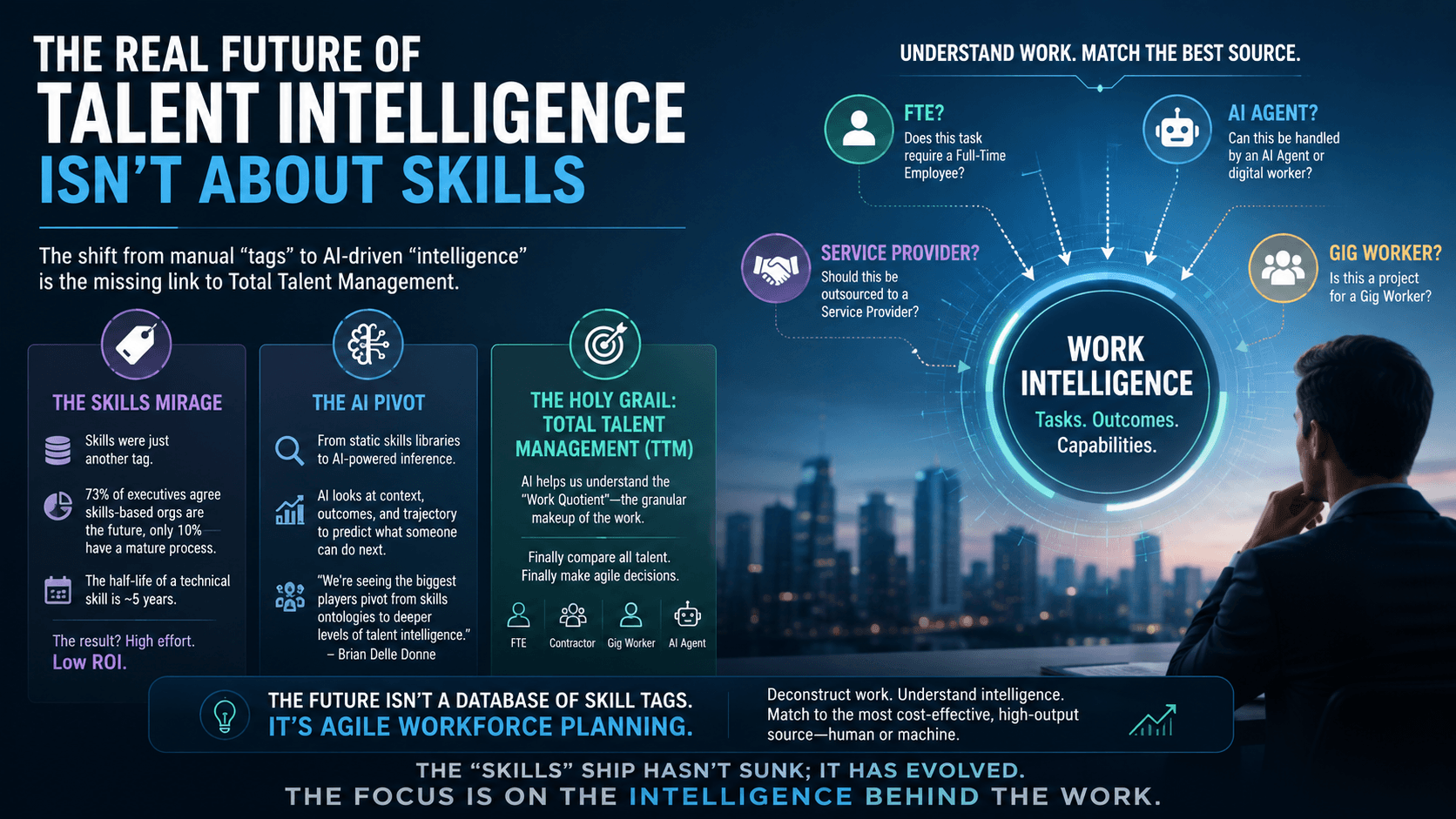
The Skills Mirage
 Brian Delle Donne Co-founder & President Talent Tech Labs
The first wave of skills-based hiring required organizations to build massive, complex "skills ontologies." This involved tagging every job and every candidate with hundreds of specific attributes.
As Delle Donne points out, "Skills, back to the very beginning, were really just another tag."
The problem is the implementation gap. Deloitte found that while 73% of executives agree that skills-based organizations are the future, only 10% actually have a mature process for it. Why? Data hygiene.
Most organizations haven't maintained the data fidelity required to make these systems effective. Furthermore, with the half-life of a technical skill now hovering around five years, a manual skill library is often obsolete by the time it's finished. For many Talent Acquisition leaders, the result became an expensive expedition with very little ROI.
The AI Pivot
Instead of asking recruiters to manually tag resumes, the industry is shifting toward inference.
With the rise of generative AI, companies no longer need a static library of skills. Modern systems can infer capability. They look at the context of a candidate's trajectory, the outcomes of previous projects, and the nuances of work history to predict what someone can do next.
"We're seeing some of the biggest players pivot and no longer lead with their skills ontologies," Delle Donne notes. "They're moving into levels of talent intelligence that allow for capabilities to be discerned and acted upon."
The Holy Grail: Total Talent Management (TTM)
Will the shift from manual "tags" to AI-driven "intelligence" be the missing link that finally enables Total Talent Management?
For decades, TTM—the idea of looking at the entire workforce (FTEs, contractors, and gig workers) as one talent pool—has remained more aspiration than reality. Why? Because organizations couldn’t compare a traditional "job description" for an employee with a "statement of work" for a contractor in any meaningful apples-to-apples way.
By using AI to move beyond basic skill tags and instead understand what Delle Donne calls the "Work Quotient" – the granular makeup of the work itself – leaders can finally make more agile workforce decisions. In many ways, this is the real breakthrough: understanding work as a collection of tasks, outcomes, and capabilities rather than static job titles.
When organizations understand the intelligence behind the work itself, they can finally ask better questions:
- Does this task require a Full-Time Employee (FTE)?
- Can this be handled by an AI Agent or digital worker?
- Should this be outsourced to a Service Provider?
- Is this a project for a Gig Worker?
Agile Workforce Planning
The future isn't about having the biggest database of skill tags; it’s about agile workforce planning, says Delle Donne. The companies that win in the age of AI won't be the ones that successfully tagged employee skills in a spreadsheet. They will be the organizations that use talent intelligence to deconstruct work into its smallest parts and then match that work to the most cost-effective, high-output source—whether that source is human or machine.
The "skills" ship hasn't sunk; it has evolved. The focus is no longer on the label: it’s on the intelligence behind the work.