HR’s Greatest Evolution: Meet the Chief Workforce Officer
AI is reshaping not just who does the work, but who owns and designs it giving rise to the emerging Chief Work Officer. As HR evolves from managing people to managing the architecture of work, demand is shifting toward strategic, AI-fluent talent, creating new opportunities for HR leaders and staffing firms.
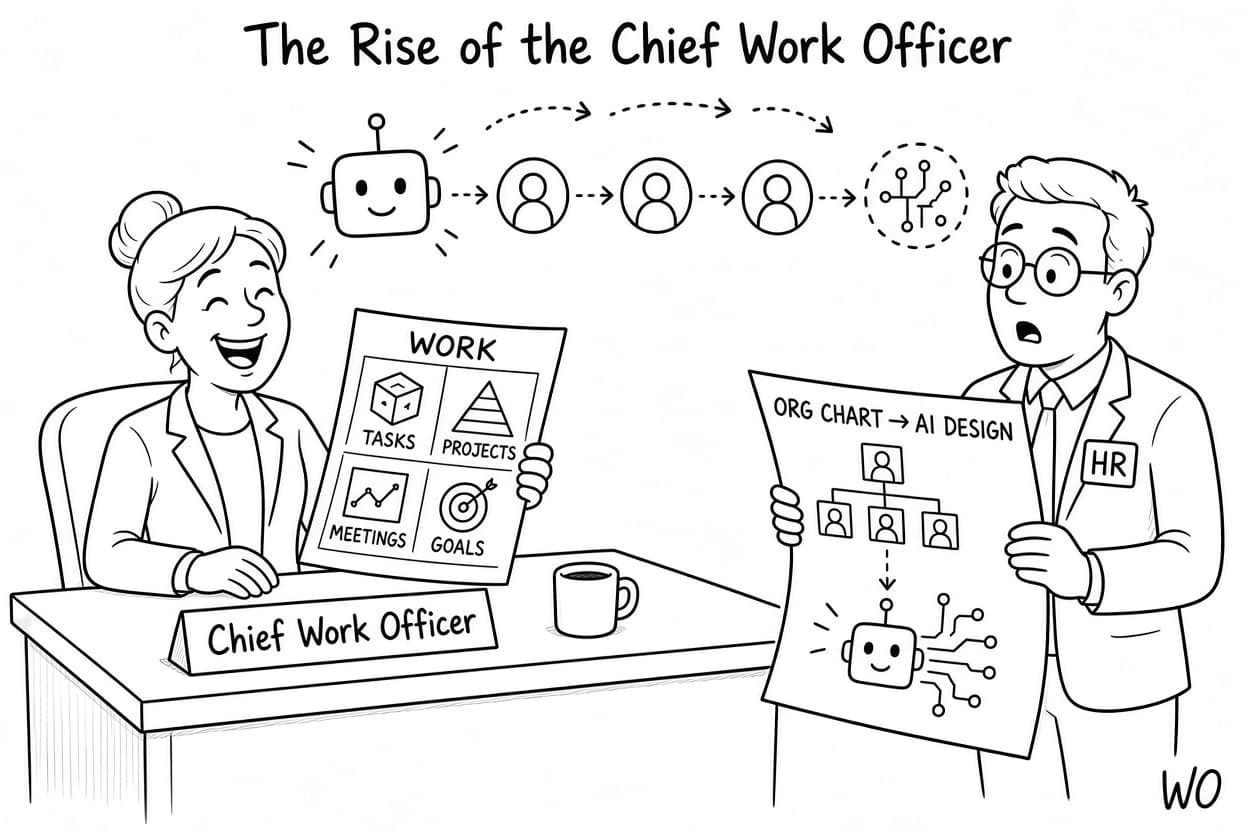
Who owns the work when the workforce is no longer entirely human?
Welcome the Chief Work Officer.
Imagine a company five years from now where a team consists of:
37 employees + 14 AI agents + contractors + an EOR workforce + freelancers + automation embedded in workflows.
Who owns the design of that workforce?
The CIO owns technology.
The COO owns operations.
The CFO owns the economics.
The CHRO owns employees and the contingent workforce.
But who owns the combination?
That’s the question the emerging Chief Work Officer concept is trying to answer. And it is becoming more urgent as AI changes not just who does the work, but what HR itself is expected to do.
Traditionally, the CHRO owns the human workforce: recruiting, compensation, benefits, employee relations, learning, culture and succession. But the CWO represents a shift from managing people to managing work.
The Rise of the Chief Work Officer
Two months ago, Johnny Taylor, CEO of SHRM, talked about the “Chief Work Officer” in his SHRM26 keynote. He described it as a role responsible for organizing how work gets done across an entire organization, regardless of whether that work is performed by people, AI systems or some combination of the two.
The role is not a new idea. Deloitte’s 2024 Global Human Capital Trends suggested that the CHRO may need to become the Chief Work Officer because organizations increasingly have work being performed by a combination of internal employees, external workers and AI.
And the shift is no longer theoretical. Gartner predicts that 15% of day-to-day work decisions will be made autonomously through agentic AI by 2028, up from essentially zero in 2024.
In June 2025, TIME/Charter published “The Case for a Chief Work Officer,” featuring Athena Karp, founder and CEO of HiredScore, which Workday acquired. Karp described the role as helping organizations manage the transition from human work toward human-machine collaboration. She argues that the CWO doesn’t necessarily own technology. CIOs, CTOs and AI leaders can continue to own technology; the CWO’s job is to understand how technology changes the work itself.
Workday has also described the evolution from CHRO to Chief Work Officer in its 2025 Workday Rising coverage, framing it around human-AI collaboration and designing more intelligent work.
Taylor told the SHRM26 audience that the CWO means moving past a preoccupation with keeping employees happy and toward being “decisive, analytical, business-first, solution-oriented and owning the full function of work” inside the organization.
In practice, that means building the analytical capability to forecast workforce shifts before they happen and being able to justify the ROI of every employee the way a CFO would justify a capital investment—the same discipline increasingly being applied to AI spending.
It’s a sharper, more accountable version of HR leadership. And Taylor framed adopting it as the way the profession can take back ownership from executives who have already started to write it off.
But here’s the kicker.
HR is not disappearing.
What the Numbers Actually Show
Current data suggests something very different. Robert Half’s 2026 research shows that HR hiring remained steady in 2025, with employers advertising 30,300 HR positions. More than half of those postings were for talent management or learning and development roles, while compensation and benefits represented 36% of HR postings.
And the demand continues into 2026. Fifty-six percent of HR leaders plan to increase permanent headcount in the second half of the year, while 50% expect to increase contract hiring. Nearly six in 10 say finding skilled HR professionals is more difficult than it was a year ago.
The unemployment numbers tell a similar story. Compensation, benefits and job analysis specialists have an unemployment rate of just 0.4%, compared with a 4.3% national rate. Human resources workers are at 1.1%, while training and development specialists are at 2.2%.
So what’s going on?
Bersin’s read is that AI isn’t eliminating HR jobs so much as changing what they’re for. His 2026 research describes an AI-driven reinvention of HR, moving the profession away from administrative overhead and toward a more strategic, “full-stack” model.
HR business partners at large employers are being pulled into more senior, consultative roles, while AI tools absorb the administrative tasks—like answering routine policy questions—that used to eat up HR’s time.
The net effect is a shift from process administration toward change management, workforce redesign and helping the rest of the organization figure out how to work alongside AI.
And that may be the real story behind the Chief Work Officer.
If AI is changing the composition of the workforce, HR’s opportunity isn’t to defend its traditional territory. It is to claim responsibility for the larger question of how work gets designed, allocated and measured.
The profession Taylor warned might face “extinction” may actually be expanding its remit—from managing people to managing the architecture of work itself.
The question may no longer be who owns the people.
It may be who owns the work.
Staffing & HR Impact
For staffing firms and internal recruiting teams, the implication is straightforward: don’t retreat from HR as a category. Get more selective within it.
The demand is increasingly concentrated in HR professionals who can combine strategic judgment, workforce planning, change management and AI fluency. Robert Half’s research shows employers are placing greater value on critical thinking and problem-solving skills alongside AI capabilities, while HR leaders report significant gaps in leadership capabilities, AI literacy and learning and development.
That creates an opportunity for staffing firms.
The HR roles that are most exposed to automation are likely to be the most transactional. The roles gaining value are those that help organizations navigate workforce change, redesign jobs, deploy technology and make decisions about how work gets done.
For recruiters, that makes upskilling more specific—not simply “learn AI,” but understanding change management, workforce planning, organizational design and AI enablement.
And for staffing firms, the emerging CWO could become an important new buyer—or, at minimum, a new way of thinking about the buyers they already serve.
Because if the CHRO is evolving into the person who owns the architecture of work, the staffing industry is no longer simply supplying people.
It is helping organizations design the workforce of the future.
Sources: Johnny Taylor, CEO of SHRM — SHRM26 keynote; Deloitte — 2024 Global Human Capital Trends; TIME/Charter — "The Case for a Chief Work Officer" (June 2025), featuring Athena Karp, founder and CEO of HiredScore (acquired by Workday); Workday — 2025 Workday Rising coverage; Robert Half — 2026 hiring research; Josh Bersin — research on HR job postings and salary growth