When the Side Hustle Became the Career
What began as a side hustle has become a permanent career path for millions of Americans. As rising costs reshape the workforce, independent work is no longer just extra income—it’s a core source of financial security, professional identity, and economic resilience. For employers and workforce leaders, this shift signals a fundamental change in how talent works, engages, and builds careers.
For years, the "side hustle" conjured up certain images: a barista writing a novel, a weekend Etsy seller, a recent graduate driving for a rideshare app to pay off student loans. It was, by definition, secondary — a supplement to the "real" job, a stopgap, temporary in nature.
That was yesterday's narrative. Welcome to the new reality: side gigs have shifted from discretionary "fun money" to a vital part of everyday financial survival for millions of Americans.
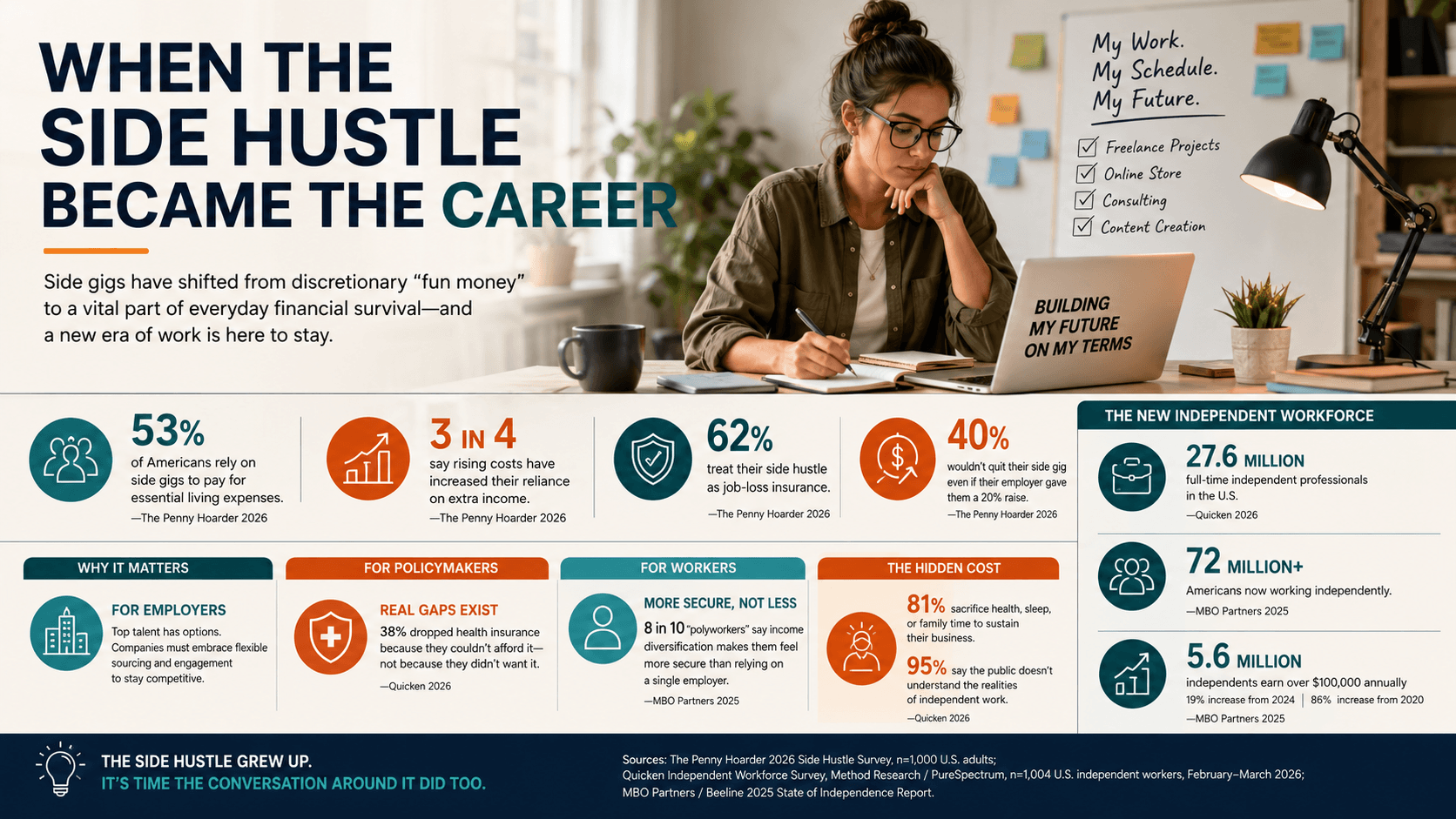
Data from The Penny Hoarder's 2026 Side Hustle Survey reveals that 53% of Americans rely on side gigs to pay for essential living expenses. Three in four respondents said rising costs have increased their reliance on extra income. Sixty-two percent say they treat their side hustle as job-loss insurance, and 40% said they wouldn't quit their side gigs even if their primary employer gave them a 20% raise. Conducted among 1,000 U.S. adults, the data makes clear that creeping inflation has forced many workers to seek extra income just to stay afloat.
A New Story
A Quicken survey, also conducted in early 2026 across more than 1,000 American independent workers, confirms the scale of the shift. There are now 27.6 million full-time independent professionals in the United States — freelancers, contractors, gig workers, and self-employed individuals who have stepped fully outside traditional employment. Three out of four of them (76%) now view this path as a permanent career choice, not a temporary arrangement.
The MBO Partners 2025 State of Independence report puts the broader picture in sharp relief: more than 72 million Americans are now working independently. A record 5.6 million independent professionals earn over $100,000 annually — a 19% increase from 2024 and an 86% increase from 2020. Seventy-four percent of independents use generative AI to improve productivity, and Gen Z now represents 28% of the independent workforce.
The motivations are also more nuanced than the standard "pushed out, not pulled in" narrative. Many were initially driven into independent work by economic necessity. But many were equally motivated by entrepreneurial ambition — a desire to own their work, set their own terms, and build something on their own. Necessity and aspiration, it turns out, are not mutually exclusive.
Why This Matters for the World of Work
The permanence of independent work isn't just a lifestyle story. It represents a structural change in how labor is organized — with profound implications for employers, policymakers, and workers alike.
For employers, the talent pool looks fundamentally different than it did a decade ago. The best people in many fields increasingly have options. They can choose project-based engagement over full-time employment, and a growing share are actively doing so. Companies that rely solely on traditional employment relationships to attract talent are fishing in a shrinking pond. Companies that rely solely on traditional employment models are fishing in a shrinking pond. To compete for top talent, they need to embrace more flexible sourcing strategies that align with how today’s workforce wants to work and engage.
For policymakers, the rise of permanent independent work exposes real gaps in the social safety net. The Quicken survey found that 38% of independent workers who dropped health insurance did so because they simply couldn't afford the premiums — not because they didn't want it. Structures built around the employer-as-benefits-provider model are straining under the weight of a workforce that no longer fits that mold.
For workers themselves, the data reveals a more complex reality than either the "freedom myth" or the "exploitation narrative" fully captures. Eight in ten "polyworkers" — those with multiple income streams — say income diversification makes them feel more secure than relying on a single employer. That’s a significant shift in how workers think about job security.
The Hidden Cost
But this isn’t a simple success story. Eighty-one percent of independent workers say they’ve sacrificed health, sleep, or family time to sustain their business, while 95% say the public doesn’t understand the realities of independent work.
For HR and workforce leaders, this matters. Independent workers aren’t simply employees without benefits — they’re running small businesses under significant pressure and need to be engaged differently.
What Workforce Leaders Should Take Away
The workers driving this economy are not supplementing a "real" job. They are building careers that require financial literacy, personal resilience, and a policy environment that recognizes them as an integral and growing part of the workforce.
For organizations watching these trends, the questions worth asking are not "how do we compete with freelancing?" but rather: How do we build talent relationships with independent workers over the long term? How do we create engagement models that respect the full context of their working lives? And how do we contribute to the policy conversations that will determine whether this workforce thrives or burns out?
The side hustle grew up. It's time the conversation around it did too.
Sources: The Penny Hoarder 2026 Side Hustle Survey, n=1,000 U.S. adults; Quicken Independent Workforce Survey, Method Research / PureSpectrum, n=1,004 U.S. independent workers, February–March 2026; MBO Partners / Beeline 2025 State of Independence Report.