Talent Is Global. Payroll Isn't.
Why cross-border hiring has become a skills play and what paying people properly actually involves
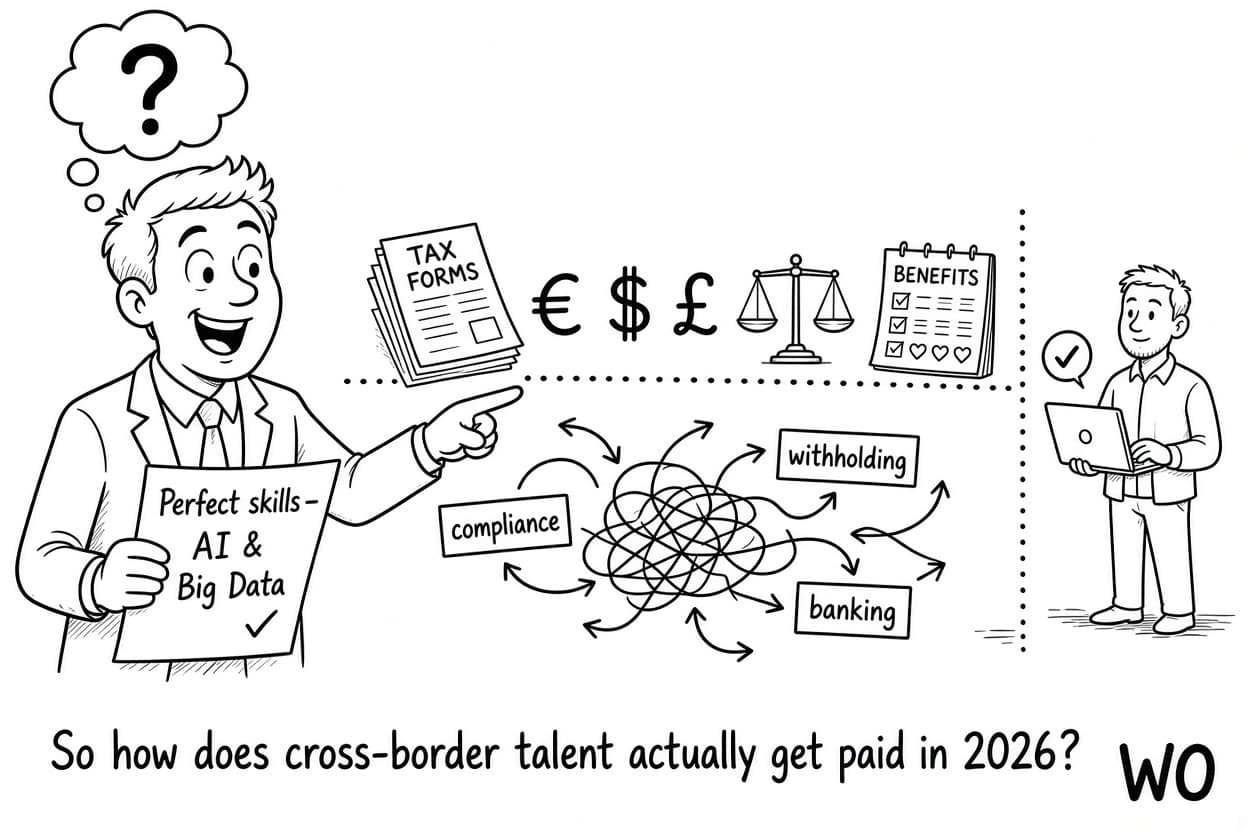
Finding people with the right skills is a priority for enterprises and startups alike.The World Economic Forum’s Future of Jobs Report 2025 identifies AI and big data among the fastest-growing skills by 2030. The report also finds that 63% of surveyed employers consider skills gaps a major barrier to business transformation, while 70% plan to hire people with new skills.
But there's a distinction worth noting. Well-funded startups (which Deel defines as those that have raised $100 million or more) aren't necessarily hiring internationally to save money. Here's what the data suggests. Deel's 2025 Global Hiring Report found that well-funded startups are expanding internationally to access specialized talent, even when they can afford to pay competitive salaries.
Broader survey data suggests cost still matters. In RemoFirst's Survey of International Hiring, Sept 2025, it polled 300 HR leaders across four markets. Sixty three percent cited access to specialized skills as a top benefit of international hiring, compared with 55% who cited cost efficiency.
The skills question may be answered, but the cost of employing someone across borders hasn't disappeared. When the best person for the job lives in Lisbon, Lagos or Lahore, finding the talent is only part of the challenge. The harder question is how to hire them, pay them and do it compliantly across borders.
That can be more complicated than finding the candidate. A salary offer is a promise; delivering it across borders involves employment law, tax withholding, currency conversion, statutory benefits and banking systems that must accommodate different countries' rules and requirements. So how does cross-border talent actually get paid in 2026?
The Talent Story
In Deel's report, hiring of general AI trainers grew 283% year over year, followed by legal case managers (164%) and medical administrative assistants (123%). The figures point to growing demand for specialized talent, while compensation varies across regions with local supply, demand and wage levels.
But finding and compensating scarce talent are only half the equation. Companies must also deliver that compensation reliably across borders. Delays, unexpected fees or shortfalls can undermine the experience of a hire they've worked hard to secure.
How Cross-Border Talent Gets Paid
Companies have several options for engaging and paying international talent. These approaches serve different purposes and aren't all alternatives to one another:
Contractor invoices: Independent contractors invoice for their work and receive payment under the terms of their agreements.
Bank wires: Companies transfer funds directly through banking networks, with fees, exchange rates and delivery times varying by corridor.
Local-currency payouts through payroll platforms: Providers can consolidate funding and distribute payments in local currencies, depending on their country and currency coverage.
Employer of Record (EOR): An EOR employs a worker on behalf of a client in a country where the client may not have its own employing entity.
Agent of Record (AOR) and local entity: An AOR can support contractor engagements, while establishing a local entity gives a company its own legal presence for employing workers, subject to local requirements.
(We'll examine each approach in next week's installment with particular attention to the employer-of-record model)
What "Pay" Means Country by Country
The deeper lesson is that compensation isn't just a number; it's a bundle of costs and obligations that varies by jurisdiction.
The Organisation for Economic Co-operation and Development's (OECD) tax wedge : income tax plus employer and employee social contributions, less relevant cash benefits, as a share of labour costs averaged 34.9% across OECD countries in 2024. It reached 52.6% in Belgium and 47.9% in Germany. These figures refer to a single worker without children earning the average wage.
In Brazil, a 13th salary is a statutory entitlement for covered employees. In India, provident-fund contributions apply to eligible workers and employers under the relevant rules. A startup that budgets simply by multiplying salary by headcount can miss significant country-specific employment costs.
Benefits follow the same pattern. Workers may expect benefits that reflect local norms, while certain benefits and contributions — including pensions, social insurance and severance obligations — may be required by law. The employment arrangement and provider's scope of service determine which obligations are handled on the company's behalf and which remain its responsibility.
Payroll Done Right
Companies managing international talent need to think beyond the salary figure: Match the arrangement to the working relationship. Independent contractors need appropriate agreements, potentially supported by an AOR. Employees may be employed through an EOR or the company's own local entity. The arrangement should reflect the actual working relationship and applicable law.
Treat foreign exchange as part of compensation. Clarify who bears currency risk, how exchange rates are determined and which payout currencies are available to the worker. Budget for the full employment cost. Model statutory benefits, additional salary payments, social contributions and mandatory employer costs by country before making an offer.
Pay attention to the last mile. Consolidated funding and local-currency payouts can simplify international payments, but fees, delivery times and settlement options vary. Reliable, predictable payments matter to workers and employers alike.
Getting People Paid Correctly
The underlying story is that capital can move faster than legal infrastructure. A startup can decide on Tuesday to hire an AI trainer in Nigeria and want them working by Monday. Finding a candidate may be quick; establishing a compliant employment arrangement and paying them correctly requires navigating local contracts, tax withholding, benefits and banking systems.
The companies that compete successfully for global talent won't just be those that find specialized people around the world. They'll also need processes to employ and pay them compliantly, without avoidable delays or shortfalls.
Because from the worker's perspective, the employer relationship comes down to something simple: does the money arrive in full and on time, every month?
The views expressed here are those of the Workforce Observer editorial team. Data cited from Deel and RemoFirst reflects their respective platforms' customers and surveys.