Why Are 92% of Employers Fighting Over the Same People?
Nobody's Hiring. Nobody's Firing. That is today’s labor market. New unemployment claims hit 197,000 in late September — their lowest level since 1969. Layoffs, per Challenger, Gray & Christmas, fell 18% month over month. Meanwhile, September payrolls grew by just 29,000, a number that missed even the most pessimistic forecast.
Employers are holding onto workers with both hands. They just aren't adding them. The Federal Reserve Bank of Cleveland calls this the "low-hire, low-fire" labor market — historically low separations paired with historically lukewarm hiring. The Richmond Fed maps it even more starkly: the current combination of weak hiring and near-record-low separations is essentially off the chart compared to the last 26 years.
So why do non-compete enforcement agreements even feature in a market where nobody seems to be moving?
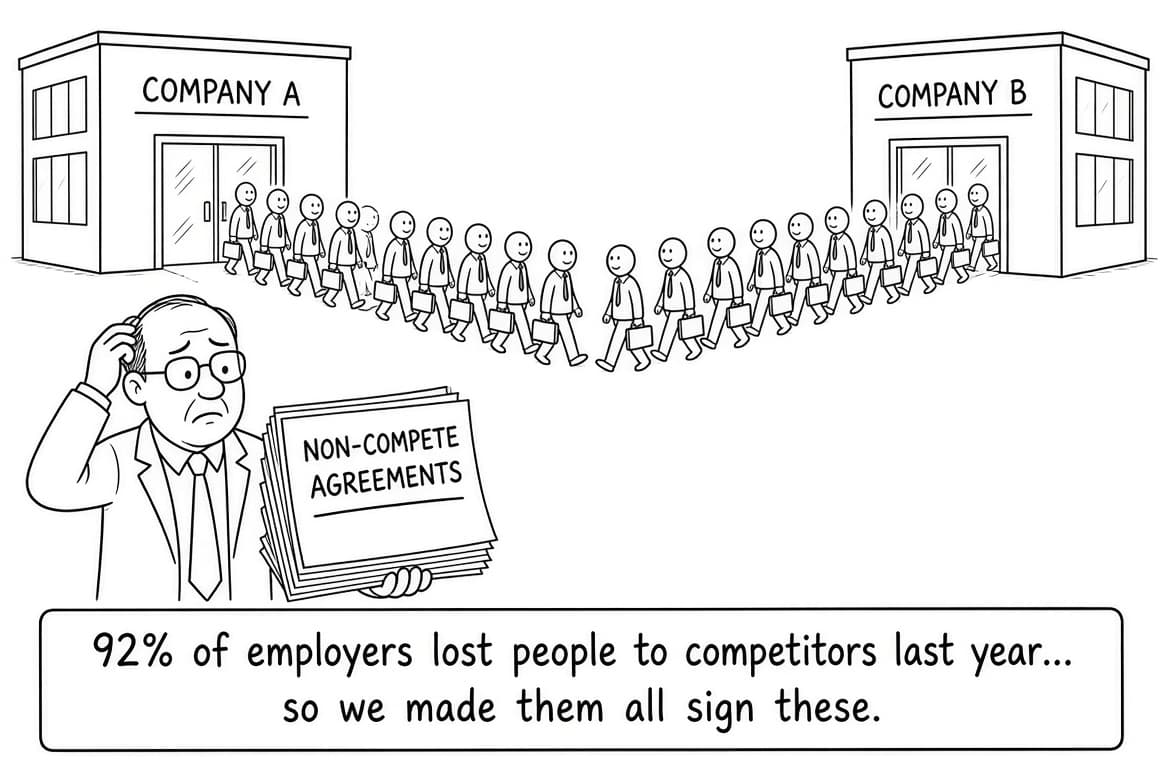
Enter Littler's 2026 Annual Employer Survey Report, released in May and completed by more than 300 U.S. executives across the US. The headline figure jumps off the page: 92% of employers lost employees to competitors in the past 12 months.
The apparent contradiction evaporates the moment you distinguish between net hiring and gross movement. The payroll number (+29,000) measures net change i.e. hires minus separations. But the Littler survey captures gross departures to competitors. Those are replacement hires. One company's loss is another company's gain. The headline number stays flat while the churn underneath it is anything but.
And when those departures happen, the violations are frequent. More than half of employers who saw workers leave for a competitor (55%) reported some kind of restrictive covenant or confidential information breach. Thirty-seven percent said employees copied, downloaded, or removed confidential information before walking out the door. And when violations occur, employers are responding sharply: 95% took some action, 81% sent cease-and-desist letters, and 35% initiated litigation. Group departures i.e. coordinated lift-outs drew the most aggressive response: 51% of employers hit with a group exit sued the departing employees.
The point is this: in a low-hire, low-fire environment, every departure matters more. Replacement talent is harder to source, so losing a key employee to a rival doesn't just sting; it strategically hurts.. The incentive to enforce non-competes and pursue trade secret claims actually increases when the broader market is frozen.
Meanwhile, the regulatory ground is shifting under everyone's feet. A tracker counting state-level non-compete bills found 101 bills pending in 34 states as of March 2026, with six new laws already passed. The labor market is telling a specific story: employers are hoarding the workers they have, fighting aggressively for the ones who leave, and the legal infrastructure governing movement is being rewritten in real time.
These agreements – non competes, non-solicits, NDAs – matter more than ever. Clauses in employment and business contracts are restricting what people can do after the relationship ends. And this is especially true of a labor market where both retention and competition are hypercharged.
When companies aren't hiring aggressively, keeping critical talent from walking out the door or taking valuable information with them becomes a much bigger strategic priority. The result is a labor market where the battle for talent doesn't stop when an employee walks out; in many cases, that's when the legal battle begins.
Sources: Littler, How Employers are Enforcing Non-Compete and Confidentiality Agreements; Federal Reserve Bank of Cleveland, The “Low-Hire, Low-Fire” Labor Market; U.S. Bureau of Labor Statistics, The Employment Situation — September 2026; Associated Press, U.S. unemployment claims dip to the lowest since mid-July; Challenger, Gray & Christmas, Job Cuts Fall in September; Fair Competition Law, 101 Noncompete Bills in 34 States, with Six New Laws (March 2026) and Mintz, Two New Non-Compete Laws Take Effect in Virginia and Tennessee.