Can You Explain Your Pay Decisions? Why a Pay Philosophy Matters Now
Publishing a salary range is the easy part. Explaining why someone is paid what they are and defending that decision is where things get complicated.
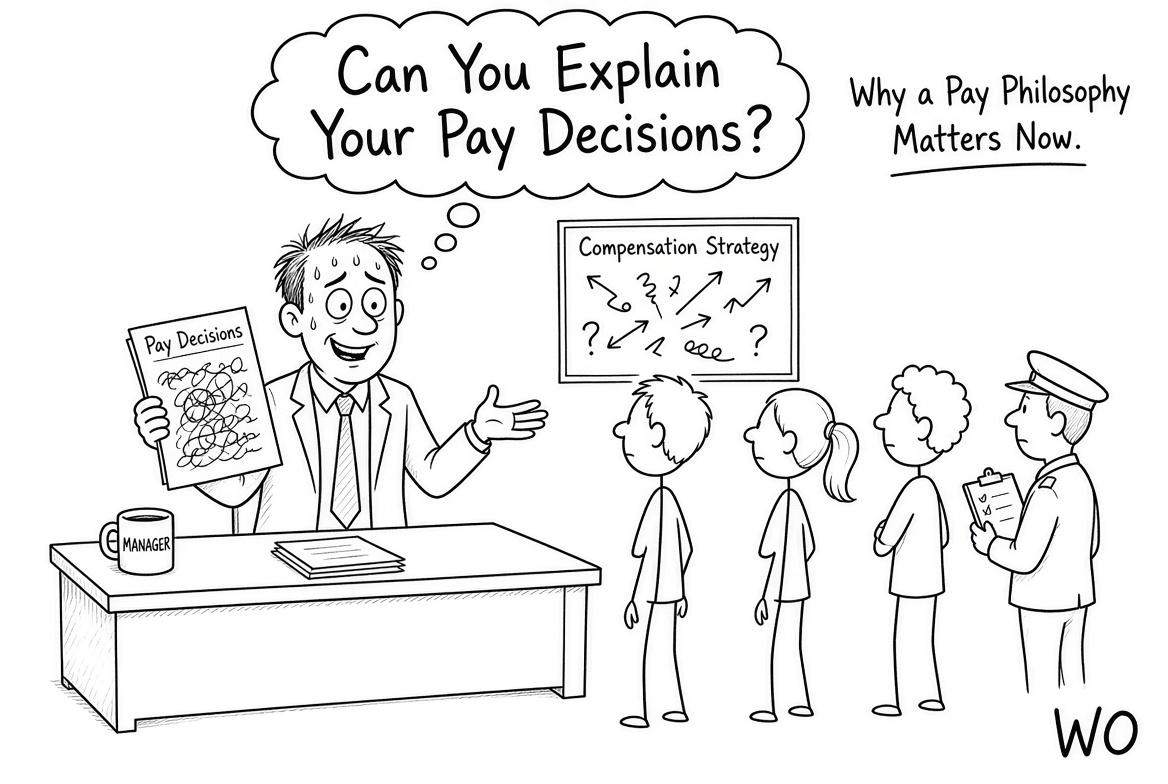
Before a company can respond to any pay transparency requirement, it helps to answer a simpler question: Can you explain your pay decisions?
Pay transparency rules are spreading across the U.S. and Europe. Companies with a clear approach to compensation may be better prepared—not because every law requires a written pay philosophy, but because consistent decisions are easier to explain.
“It really comes back to a pay philosophy … and a strategy,” says Shawn McIntire, Chief Legal and People Officer at Pebl, an employer of record (EOR) provider that supports hiring in more than 185 countries. “If you don’t have that, then you will not be able to comply with the pay transparency rules.” For McIntire, having a clearly defined pay philosophy and strategy is fundamental to preparing for the growing demands of pay transparency.
The specific rules vary by jurisdiction. As of Nov. 20, 2026, 14 states and Washington, D.C., require employers to include pay information in at least some job postings, although coverage and disclosure requirements vary. Virginia and Maine's laws took effect in July, and Connecticut's proactive disclosure requirement took effect Oct. 1.
In the EU, the June 7, 2026, deadline for Member States to transpose the Pay Transparency Directive has passed. Implementation across countries remains uneven, leaving employers to navigate a changing patchwork of national requirements.
The Directive also provides for a shift in the burden of proof in certain cases—for example, when a worker establishes facts from which pay discrimination may be presumed, or when an employer has failed to meet specified pay transparency obligations.
Start with the band, then pick your spot
A pay philosophy is put into practice through pay ranges for roles or job levels, informed by market data from sources such as Aon’s Radford McLagan Compensation Database, Mercer and Pave to name a few. The next decision is where the company wants to position its pay against the market—and how an employee’s pay should progress within the company’s range.
A company running a high-volume, cost-conscious team might target the 30th or 40th percentile of market pay. One competing for scarce talent might target the 60th or 70th. Neither approach is inherently wrong, but the choice should be deliberate. Market positioning is different from where an individual sits within a company’s own pay range.
That framework also helps managers recognize when an offer or pay decision is within the range or outside it. Without ranges, McIntire says, “you don’t know when you’re falling inside or outside of those bands.”
Exceptions are fine. Surprises aren’t.
“There are always going to be outliers,” McIntire says. A hire may bring more education, rarer experience or a hard-to-find skill. The point is being able to explain why. For instance, Pebl has been through more than 10 pay equity audits worldwide. Showing how the company makes compensation decisions and handles exceptions helped in each one. Companies should avoid having an inconsistency surface for the first time during an audit.
Where it breaks down: Managers
Pay frameworks are often established by HR or executive leadership. But “where the rubber meets the road,” McIntire says, is with frontline managers, who have to explain why someone got a 5% merit raise or isn’t moving up a band. Those conversations can make or break an employee’s trust.
Transparency doesn’t mean everyone sees everyone else’s pay. Under the EU Directive, employers must make their pay-setting and pay-progression criteria accessible. Workers can request information about their own pay level and the average pay levels, broken down by sex, for categories doing the same work or work of equal value. The Directive does not require disclosure of named colleagues’ pay or prescribe a particular pay-band structure.
The EOR wrinkle
For EORs, there’s an added complication. In many EOR arrangements, the EOR is the contractual employer, but the customer may make or substantially influence compensation decisions. “Who’s responsible for what?” has become one of the most common questions McIntire hears.
The allocation of obligations can depend on national rules and the specifics of the arrangement; it isn’t always clear-cut. McIntire’s concern is that an EOR may serve many customers with different pay approaches, making it important to be clear about who sets pay, who documents the rationale and who responds to a regulator.
His advice for buyers: ask any provider for its position on pay transparency, both for its own employees and for those it employs on your behalf.
Putting a Pay Philosophy into Practice
Define pay ranges by role and location.
Decide how you want to position pay against the market, and document why. Record and explain exceptions.
Train managers to communicate pay decisions consistently.
If you use an EOR, clarify who is responsible for each part of the process—and who responds when a regulator calls.
The rules will keep changing. A clear pay philosophy can help ensure your compensation decisions remain consistent as they do.
https://www.linkedin.com/in/shawn-mcintire-35777213/
This article is based on a conversation with Shawn McIntire recorded for the Workforce Observer podcast.