For EOR Customers, the Real Test Is Getting Fast, Reliable Answers
Choosing an employer of record is about more than the ability to hire across borders. For companies, the real test comes when they need an answer: Is the information accurate, and how quickly can a provider resolve an issue?
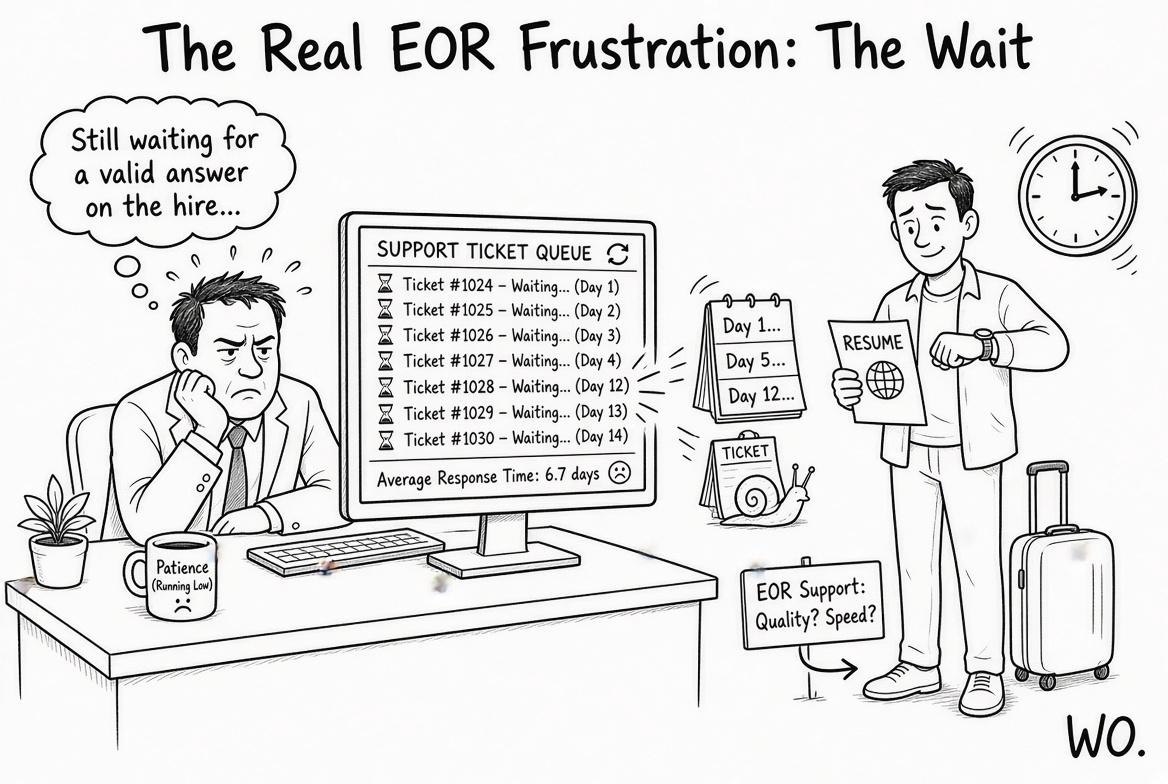
Ask companies that hire across borders what frustrates them most about their employer of record (EOR), and price rarely tops the list. More often, it’s the wait: for an answer, a fix, or confirmation that what they were told is still accurate.
Patrick MacKelvie, chief revenue officer at Pebl, gets the aggravation. On B2B software and services review platforms such as G2 and Trustpilot, he says, two recurring complaints stand out:“The quality of information they're getting back. So is it valid information from a legal standpoint, from a tax standpoint, or what have you? The second one is speed to resolution.”
The frustration is understandable. If a company is trying to land a critical hire and can’t get an answer to a follow-up question, the delay can slow the business. Labor rules are constantly changing, and a support ticket sitting in a queue for days or weeks doesn’t help.
Customer reviews offer examples of these concerns. Complaints about EOR providers mention slow responses, time-zone gaps and delays resolving invoicing issues. Some reviews describe poor customer service, with initial responses taking as long as four days. Those comments aren’t necessarily representative of the whole market, but they point to a question buyers should ask: how quickly and how reliably will a provider respond when an issue matters?
Speed is only half the problem. The accuracy of the information matters just as much. ADP's 2026 global payroll survey of 1,816 payroll professionals in 20 countries found that 47% cited the application of new legislation as one of the top two causes of payroll inaccuracies. A UKG and KPMG study of large multinational organizations found that nearly 40% of respondents reported annual payroll losses of $1 million to $5 million. Strada's research estimates that 2.6% of annual payroll spend is lost to errors, rework, compliance failures and inefficiencies.
These studies cover global payroll broadly, not EORs alone. They don’t measure EOR provider performance, but they show why payroll accuracy matters. A fast answer that’s wrong can be more damaging than a slow one.
This is happening in an industry that MacKelvie describes as “predicated on white-glove service.” But, in his view, traditional white-glove service can be difficult to scale because it requires ever-larger support teams. “So Pebl made a material decision to invest in agentic AI and build out a more time efficient solution to deliver quality information to our prospects and clients around their questions with global work,“ says MacKelvie. Pebl’s AI agent, Alfie, provides what the company describes as instant validated answers while relying on its network of human legal and compliance experts for more complex matters. MacKelvie compares it to grocery delivery: convenience for most orders, with the option to hand-pick the steak when it matters.
The question for buyers isn’t simply whether a provider uses AI. It’s whether the answers are accurate and current. In addition, whether a human specialist steps in when needed. Timely, reliable answers are part of what companies should expect when they engage an EOR.
What an EOR does and doesn’t do
Companies choose the EOR model for several reasons. Respondents to the Global Atlas Report 2026 most often cited avoiding the time and cost of establishing a legal entity, providing a more employee-like experience than contractor arrangements, and retaining flexibility as hiring needs change. An EOR can be particularly useful when a company wants to hire a small number of employees in a country or test a market before making a larger investment.
But an EOR doesn’t find the talent, and using one doesn’t automatically resolve every legal, tax or workforce question. The OECD notes that cross-border work can raise issues involving tax residence, social security, labor law and immigration rules. In some circumstances, an employee’s presence and activities can also raise questions about whether the employer has a taxable presence in that country.
The EOR model also shouldn’t be confused with a staffing agency. An EOR generally handles the employment relationship for a worker the client has selected; it isn’t necessarily responsible for recruiting that person. And while an EOR may simplify local administration, the client still needs to consider the arrangement’s cost, its impact on worker experience, the division of responsibilities and its fit with long-term plans.
Before signing, ask for response-time commitments based on the severity of an issue. Find out how the provider communicates legal changes, how quickly it does so, and when a human specialist will step in. Then test the service yourself: submit a real question during the trial and time the response. The gap between a sales demo and a Tuesday-afternoon payroll problem can tell you a lot.
MacKelvie’s closing advice to the industry is simple: “Keeping service at the heart of what you do is so important. ... You can solve for it in different ways, like with agentic AI, but the needs of the customer always have to be central.”
https://www.linkedin.com/in/patmack/
This article is based on a conversation with Patrick MacKelvie recorded for the Workforce Observer podcast.