Cross-Border Hiring: Ways to Engage and Pay Talent
From contractor invoices to an Employer of Record, each model solves a different problem and comes with different trade-offs.
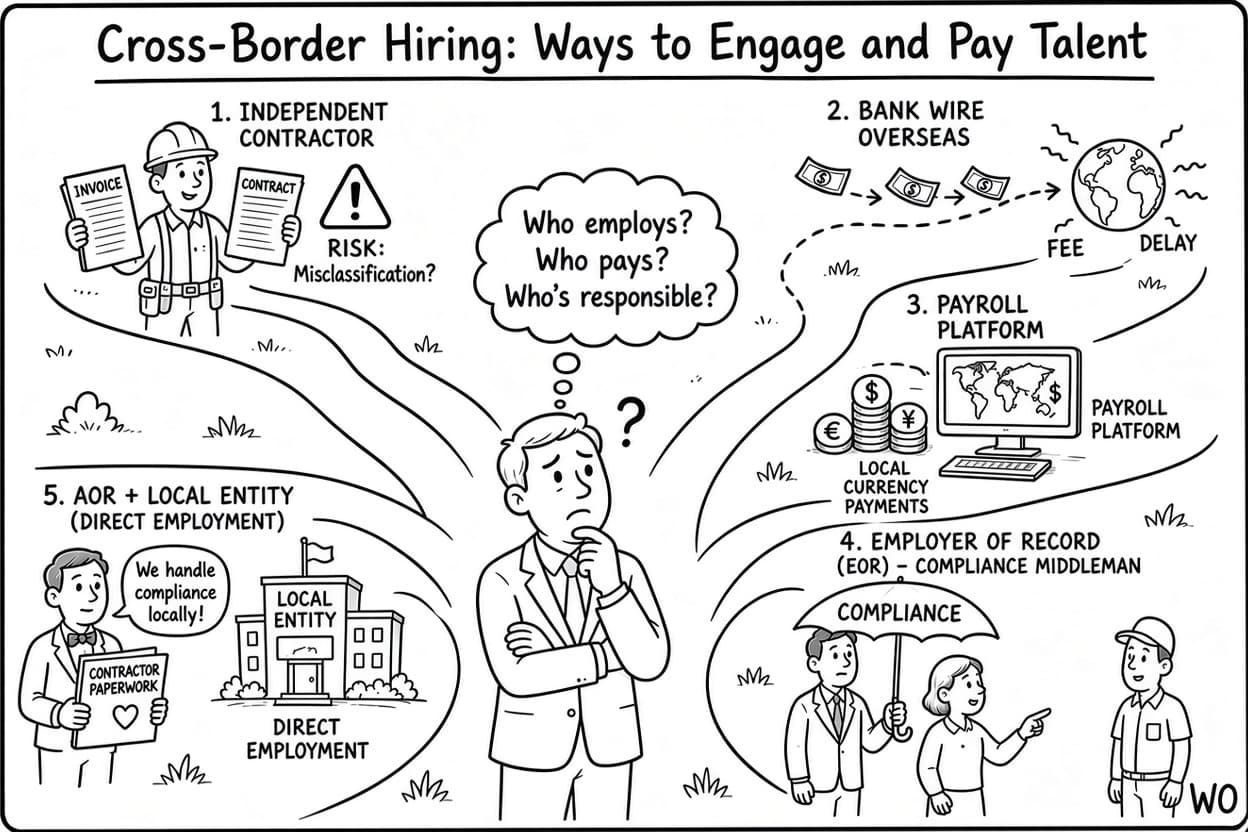
In the first post in this series, the Workforce Observer team outlined several ways companies can engage and pay international talent. They may look like alternatives, but they don't all solve the same problem.
Some determine the worker's relationship with the company. Others move money or administer payments. A bank wire, for example, doesn't make someone an employee—or a contractor. And a payroll platform doesn't necessarily become the employer.
Here's what each model can do, and where its limits lie.
Contractor Invoices
An independent contractor invoices for work under an agreement. This can suit a genuinely independent professional or a defined project, and it may give both sides flexibility. But the contract and invoice don't, on their own, determine the worker's legal status. That depends on the working relationship and the rules in the relevant country. If the person functions like an employee, treating them as a contractor can create legal and financial risk.
Best fit: A properly classified, independent service provider—not simply someone the company wants to pay without setting up payroll.
What to consider: Contractor invoices can be flexible, but misclassification can trigger back taxes, benefits claims and penalties. There is no single cross-border penalty, because the consequences depend on the country and the facts of the working relationship.
Bank Wires
A bank wire is a way to transfer money internationally. It may be perfectly adequate for occasional payments or straightforward supplier relationships.
The trade-offs are practical: fees, exchange rates, delivery times and payment tracking can vary. And wires don't handle payroll calculations, employment obligations or worker classification.
Best fit: Moving funds when the underlying arrangement is already clear.
What to consider: Bank wires move money, but they don't provide payroll administration, tax withholding or employment compliance. Companies need to ensure these responsibilities are addressed separately.
Local-Currency Payouts Through Payroll Platforms
Some platforms help companies coordinate payments and distribute funds in local currencies. That can simplify administration for teams paying people in multiple countries.
The details vary by provider: country coverage, currencies, fees and services differ. Some platforms focus on payment processing, while others offer broader payroll administration. A platform may support payment operations without employing the worker or resolving whether the worker should be an employee or contractor.
Best fit: Managing payment workflows or payroll administration alongside an appropriate employment or contractor arrangement.
What to consider: Local-currency payout platforms can simplify administration, but coverage, fees and services differ by provider. A payment platform doesn't necessarily resolve worker classification or employment obligations.
Employer of Record (EOR)
An EOR employs a worker on behalf of a client company in a country where that company doesn't have its own employing entity. The EOR typically manages local employment administration, including payroll and required contributions; the client directs the worker's day-to-day work.
For companies testing a new market, an EOR may offer a way to hire before committing to a local entity. As Pebl’s Chief Business Officer, Dutta Satadip, put it in a June Workforce Observer podcast: “One of the very important points about compliance is when you're entering new markets, you don't know if you're going to be successful in that market. So you may want to try out a market by putting two people there to see if it will pan out. Many customers will put in, let's say, one or two salespeople to test that market and see if it will grow. And should the market grow, of course customers will add more people and then eventually create an entity. But if they don't grow, they want to exit the market. And EOR becomes an amazing construct because the risk of exit is borne by the EOR, not the company. The company doesn't bear that risk. So that's where the flexibility comes in.”
There are trade-offs. EOR fees add to the cost of employment, and the company relies on its provider's local expertise, service and coverage. An EOR can help manage local requirements, including compliance, but it doesn't automatically eliminate the client's responsibilities. Who is responsible for what depends on the arrangement and the laws in the relevant country.
Best fit: Hiring an employee in a country where the company lacks an entity, particularly when it wants to start without building a full local operation.
What to consider: EORs add a recurring service fee. An October 2026 pricing comparison by Second Talent found published EOR fees ranging from $99 to $699 per employee per month, before salary and statutory contributions. Actual pricing varies by provider, country and service scope.
AOR and Setting Up A Local Entity
An Agent of Record (AOR) may help administer contractor engagements, but its services and responsibilities vary by provider. These can include contracts, documentation, payments and classification support. An AOR doesn't automatically become the legal employer or make a contractor classification correct.
A local entity, by contrast, gives the company its own legal presence in a country and can support direct employment. It offers more direct control, but also brings setup and ongoing responsibilities, including local payroll, tax and employment administration.
Best fit: An AOR for support with contractor administration; a local entity when the company has a sustained reason to operate and employ directly in that country.
What to consider: AOR services and responsibilities vary by provider. Entity setup and operating costs depend heavily on the country, the number of employees and the company's business needs.
The Right Approach
Regardless of which model a company chooses for engaging and paying international talent, the right route depends on the work, the worker's legal status, the number of hires and the company's plans in that country.
First decide what kind of relationship you need. Then choose how to administer it and move the money. The question isn't just how to pay international talent. It's who employs the workers and who takes responsibility for the relationship.